


PVC Edge Banding

Yimin Edgebanding Decorative Material Co.,Limited
Yimin Edgebanding Decorative Material Co.,Limited is a professional manufacturer of furniture edge banding tape, office pvc edge band, cabinet pvc edge band strip and heterromorphic edge band and ABS edge band tape which was established in 2008.
Why choose us?
Professional Solution
With rich experience and one-to-one service, we can help you choose products and answer technical questions.
Quick Transportation
We cooperate with professional sea shipping, air and logistics companies to provide you with the best transportation solution.
Quality Assurance
Each batch of goods has a corresponding quality inspection report to solve your concerns about product quality.
After-sales Services
Customer service will update you the logistics information of the goods in time to ensure that the goods are delivered in time.


What is PVC Edge Banding
PVC Edge Banding comes in a variety of thicknesses. Usually, these products are between.018 and 1MM in thickness. Heavy-duty uses require thicker materials. For a stronger, more durable product, you can use 3MM or higher edge banding.
Advantages of PVC Edge Banding
Cost-Effective: PVC edge banding is generally more affordable compared to other edge banding materials like solid wood or metal, making it a cost-effective choice for budget-conscious projects.
Wide Variety: It is available in a wide range of colors, patterns, and finishes, allowing you to match or complement the appearance of the substrate material or achieve various design aesthetics.
Durability: PVC edge banding is highly durable and resistant to wear, impact, moisture, and most household chemicals. This makes it suitable for both residential and commercial applications.
Easy to Clean: The smooth surface of PVC edge banding is easy to clean and maintain, making it suitable for use in kitchens, bathrooms, and other areas prone to spills and stains.
Flexibility: PVC edge banding is flexible and can be easily applied to curved or contoured edges, providing versatility in design and application.
Consistency: It offers consistent color and pattern throughout the length of the roll, ensuring a uniform appearance when applied to multiple edges.
Ease of Installation: PVC edge banding can be applied using hot melt adhesive, making it relatively straightforward for both professionals and DIY enthusiasts to work with.
How to Install PVC Edge Banding?
PVC is the abbreviation of polyvinyl chloride. It is a type of plastic polymer and is the world's third-most widely produced synthetic plastic polymer.
There are two forms of PVC – rigid and flexible. It is used in pipes and applications such as doors and windows. But also very commonly used to cover edges in all types of furniture related applications.


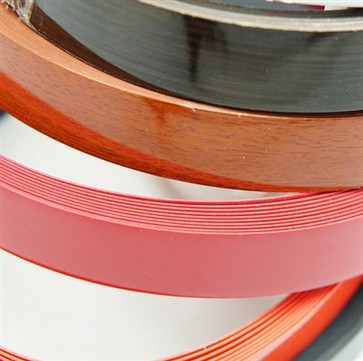

What is edge banding?
Edge banding creates a durable and contrasting finish for all the decorative surfaces using a narrow strip of material. That helps in covering the exposed sides of the materials. It gives aesthetically pleasing trim edges and the appearance of reliable or more valuable material.
On similar lines, PVC edge banding is made of vacuum molding, mixing, calendering, and other processes. A few of the types include PVC edge bands, glued edge bands, and 3D edge bands. Most PVC edgebanding is applied automatically with machines, but it is also easy to apply manually with several options.
Step 1: Measure and cut the PVC edge banding as per the requirement.
Step 2: Apply the contact cement to PVC edge banding and the material with a brush or spray contact cement . Avoid overdoing it. Another option is 2 sided PSA tape which can be stuck to either surface
Step 3: Let the contact cement dry to touch. Then, bond the material and PVC edge banding. The 2 sided PSA tape is peel off of the roll and applied to either surface.
Step 4: Remove the excess PVC edgebanding using a utility knife, router or edgebanding trimmer.
Step 5: You can use the acetone to remove the excess contact cement. Make sure it is not harming the semi-gloss finish. Otherwise, it may put a whitish layer on the PVC, making you replace the whole edge.
Before you start with the process of PVC edge banding, make sure you have left a good amount of room for any alterations to be made later.
Tips while Installing Edge Banding
Use a masking tape to cover the face of the board and protect it from overspray or excess from brush.
Avoid using sandpaper to finish installing. It is preferable to use a fine metal file.
To complete the flushing process, use a nick-less sharp chisel on a laminated or melamine board.
And use mineral turps to remove any extraneous adhesive. Acetone works also.
There is a slight difference between installing PVC Edge Banding and the rest. Here are a few points that will help you make your decision easier.
PVC edge banding provides a superior appearance to the edge of furniture or shelving.
PVC edgebanding also comes with hot melt adhesive in limited colors that will not tolerate direct heat from and iron.
They are cheaper than any other plastic and more resistant to solvent and UV lights.
PVCs are durable and scratch resistance. So, it wouldn't cause you a fortune if it is not handled correctly during its installation.
It offers a wide range of colors, textures, and finishes. Thus, you can have customized PVC installed.
PVCs are impermeable and flexible. Hence, they are easy to cut and apply.
Dirty cut edges, splintering, or tearing are generally elimanted.
It makes use of a minimum glue line for maximum adhesion since it has a concave back surface.
Edge banding serves as a veneer, a thin layer of material, mostly used to conceal the exposed and unsightly edges of plywood and other materials like MDF. This decorative concealment helps provide a perfectly finished look by mimicking the appearance of solid wood edging.
One of the primary types of edge banding materials commonly known and broadly applied is the adhesive-prepped veneer, also referred to as the 'iron-on.' Plywood sides, furniture, cabinet backs, and countertops are some of the many applications of edge banding, demonstrating its wide use in interior decor and furniture-making industries.
The benefits of using edge banding are immense. First, it covers the rough edges of your substrate, improving aesthetics while aiding in resilience against wear and tear, hence extending the lifespan of your furniture. It curtails any chances of splintering, providing clean finishes and smooth edges, whether straight, circular, or radial edges.
Given the variety of thicknesses, materials, and widths of edge bands, there's virtually no limit to the range of applications for this transformative element of DIY and commercial projects.
Edge Banding Materials: PVC, Veneer, ABS, And More
There are many different types of edge banding, the most popular being PVC, veneer, ABS, and melamine.
PVC edge banding, which stands for Polyvinyl Chloride, is favored for its durable properties, resilience to moisture, and a wide variety of colors, making it a fitting choice for kitchens and bathrooms.
Veneer edge banding is a thin layer, typically made of real wood veneer such as walnut, maple, mahogany, or cherry. This edge banding material offers the aesthetic appeal of real wood and matches perfectly with wood panels, making it great for furniture edge banding.
On the other hand, ABS, or Acrylonitrile Butadiene Styrene, is a plastic edge banding material renowned for its impact resistance and high temperatures endurance.
Melamine, another prevalent type of edge banding, provides a clean, glossy finish and is a favored edge banding for cabinets.
Each of these materials possesses unique attributes, making them better suited to certain projects over others. Therefore, understanding the pros and cons of each type of material can prove beneficial in determining the right one for your specific needs.
Pros And Cons Of Common Edge Banding Materials
When you're selecting the right material for edge banding, considering its advantages and disadvantages can guide you toward an informed decision.
For instance, PVC edge banding is remarkably durable and moisture-resistant, making it suitable for rooms with high humidity. On the downside, some individuals perceive its aesthetic as a bit synthetic compared to real wood veneers.
ABS, like PVC, is durable and flexible. It's environmentally friendly since it's made without chlorides. The drawback, though, may not provide as natural an appearance as a veneer or solid wood edging.
On the other hand, veneer edge banding provides an authentic wood finish, enhancing the overall aesthetic appeal of your project. But the cost can be a bit high compared to PVC and ABS, and veneer might not offer the same level of moisture resistance.
Edge banding made from melamine is heat resistant and offers a fine and smooth finish. Still, it might chip over time, more so than the other materials.
Edge Banding Sizes: Thin, Medium, And Thick Options
Edge banding comes in various sizes catering to different applications. The common classifications are thin, medium, and thick options, typically ranging from 0.018 inches to 3mm in thickness.
The thin edge banding, usually below 1mm, is suitable for projects requiring a near-seamless product like decorative panels and top-quality furniture work.
Medium-width edge banding typically falls in the range of 1mm-2mm and is often the go-to choice if you're designing furniture that requires a strikingly smart design and product durability.
Lastly, thick edge banding often exceeding 2mm, adds a substantial feel to your products, making it ideal for more demanding applications such as worktops and areas exposed to heavy wear.
ABS Edging Vs. PVC Edging
In the world of furniture production and interior design, the quality of the final product relies heavily on the materials used. One crucial element that can make or break the aesthetics and durability of a piece of furniture is the edging. Edgebanding is used to cover the exposed sides of materials like original wood, plywood, particleboard, or MDF, giving a more finished and professional appearance.
Two of the most popular materials for edgebanding are ABS (Acrylonitrile Butadiene Styrene) and PVC (Polyvinyl Chloride). In this comprehensive guide, we will explore ABS Edging vs. PVC Edging to help you determine which one offers the best value for your business.
Complete Comparison For ABS Edge Banding Vs. PVC Edge Banding In 12 Aspects:
|
Parameter |
Important Level |
PVC Edge Banding |
ABS Edge Banding |
|
Laser Edgebanding |
***** |
PVC edge banding is not good for Laser edge banding. It will emits harmful gases of plastic odor when burned and is not recommended for laser as it may directly burned. |
ABS edge banding is perfect for laser edgebanding due to fire resistance and no harmful gas emissions. Minimum thickness of 1mm recommended. |
|
Environmental Impact |
**** |
PVC can be recycled but emits harmful gases when burned. Takes a longer time to decompose. |
ABS edge banding is considered “Green” and more environmentally friendly. Decomposes faster than PVC and provide none air pollution. |
|
Cost Comparison |
**** |
PVC edge banding is cheaper than ABS and other plastic materials. |
ABS edge banding is more expensive than PVC and other plastic materials. |
|
Fire Resistance |
*** |
PVC edge banding is fire resistant but can release toxic fumes when burned. |
ABS edge banding is more fire-resistant and releases fewer harmful fumes when burned. |
|
Color Strength |
*** |
In Maxave, we use the same printing technology for both PVC and ABS, making them at the same color strength level. |
For ABS edge banding, it is high gloss so good for white edges, and it will need to use higher quality pigments to prevent yellowing or fading on plain colors. |
|
Surface Texture |
*** |
PVC has a smooth and consistent surface texture, also can be done with wooden grain, to make it more like a real wooden feeling. |
ABS edge banding has a slightly rougher surface texture, making it better suited for certain design styles and aesthetic preferences. |
|
Resistance to Impact |
*** |
PVC edge banding is less impact-resistant than ABS and can dent and scratch more easily. |
ABS edge banding is more impact-resistant and can withstand more wear and tear. |
|
Durability |
** |
PVC is more resistant to UV light and solvents. Can resist with strong solvents. |
ABS is lesser resistance to strong solvents and UV light. |
|
Flexibility |
** |
PVC edge banding is more flexible than ABS, which can make it easier to manipulate, such as fitting for rounded corners during installation, but also more prone to warping over time. |
ABS edge banding is less flexible which can make it more difficult to manipulate during installation but also more durable over time. |
|
Chemical Resistance |
** |
PVC is strong resistance to acidic chemicals, but is not as resistant to alkaline or basic chemicals. |
ABS is resistant to both acidic and basic chemicals, but is degraded by some household solvents. |
|
Heat Resistance |
** |
PVC edge banding can soften and warp in high temperature environments. |
ABS edge banding has a higher tolerance for high temperature environments and is less prone to warping or melting. |
|
Discoloration |
** |
PVC can discolor over time, especially when exposed to UV light or when coming into contact with certain chemicals. |
ABS is less likely to discolor over time and can maintain its color better than PVC. |
User Recommendations And Reviews: Insights From Business Owners And Customers:
When evaluating ABS edge banding vs. PVC edge banding, it's essential to consider the experiences of other business owners and customers who have used these products. In general, both ABS and PVC edgings have received positive reviews for their durability, appearance, and overall quality. However, some users note that PVC edge banding is more beneficial to work with, as it is more flexible and can be processed more conveniently on existing edge banding machinery.
Comparing the market share of usage, PVC edge banding is still the NO.1 in this field, seizing around 45-50% of the market. While ABS edge banding is around 10-15% of market share. So it is still easier to get a whole upstream and downstream supply for PVC options.
Both ABS and PVC edgings have their unique strengths and weaknesses, and the best choice for your business will depend on your specific needs and priorities. While ABS is more environmentally friendly and easier to work with, PVC offers affordability and resistance to solvents. Ultimately, it's essential to thoroughly evaluate the factors discussed in this guide to determine which material offers the best value for your business.
PVC Edge Banding In the Kitchen: Trends and Applications
The kitchen, often referred to as the heart of the home, is a space where aesthetics meet functionality. Every detail in the kitchen contributes to its overall design, and PVC edge banding has emerged as a versatile and practical solution for adding the finishing touch to various elements. In this article, we will explore the trends and applications of PVC edge banding in modern kitchen design.
Trendy Designs and Colors
One of the key advantages of PVC edge banding in the kitchen is its wide range of available designs and colors. Traditional kitchens often feature wooden edges, but PVC edge banding opens up a plethora of possibilities. From sleek and contemporary to warm and rustic, the diversity of PVC edge banding options allows homeowners to customize their kitchen according to their personal style.
In recent years, there has been a noticeable shift towards minimalist and monochromatic kitchen designs. PVC edge banding, with its ability to seamlessly blend into cabinet surfaces, contributes to this trend. Matte finishes and neutral tones are particularly popular, providing a clean and sophisticated look that complements modern kitchen aesthetics.
Applications in Cabinetry and Countertops
PVC edge banding finds extensive application in cabinetry and countertops, enhancing the durability and aesthetics of these essential kitchen components. The edges of cabinets, especially in high-use areas, are prone to wear and tear. PVC edge banding not only protects these edges from damage but also adds a polished and cohesive look to the overall kitchen design.
For countertops, PVC edge banding serves both functional and decorative purposes. It provides a protective barrier against moisture and impact while offering a seamless and visually appealing transition between the countertop surface and the surrounding cabinetry. This integration creates a unified and well-finished appearance.
Durability and Low Maintenance
The kitchen is a space where spills, heat, and frequent cleaning are inevitable. PVC edge banding, known for its durability and resistance to moisture, is well-suited for the demanding kitchen environment. It withstands daily wear and tear, ensuring that the edges of cabinets and countertops maintain their integrity over time.
Moreover, PVC edge banding is easy to clean, requiring only a mild detergent and a soft cloth. Its non-porous surface prevents the absorption of stains, making it a practical choice for busy kitchens where cleanliness is a top priority.
Innovations in Texture and Finish
Advancements in PVC edge banding technology have led to innovations in textures and finishes, offering homeowners the opportunity to create distinctive kitchen designs. Whether it's a wood-grain texture that mimics the warmth of natural wood or a high-gloss finish for a modern and reflective look, PVC edge banding provides a versatile canvas for kitchen designers.
The introduction of 3D printing technology has further expanded the design possibilities of PVC edge banding. Intricate patterns and textures can be applied, allowing for intricate detailing that adds character to kitchen surfaces. This versatility enables homeowners to achieve a customized and unique kitchen aesthetic.
In conclusion, PVC edge banding has become an integral element in contemporary kitchen design, offering a perfect balance of functionality and style. Its versatility, durability, and diverse design options make it a preferred choice for homeowners and designers alike. As kitchen trends continue to evolve, PVC edge banding is sure to play a crucial role in shaping the aesthetics of this vital living space. Whether it's a classic kitchen with warm wood tones or a sleek, modern design with monochromatic elements, PVC edge banding seamlessly integrates into the diverse tapestry of kitchen styles.
Our Factory
Founded in year of 2008, covers an area of 13000 m2,more than 120 professional staffs, is a professional modern enterprise engaged in developing and producing series of edge banding,cladding door, cladding lines and Aluminum alloy sliding door used for office furniture, civil furniture, kitchen cabinet, bathroom, laboratory, as well as, sell other furniture hardware accessories etc. Our sale network has covered all the big cities, products are exported to the Europe and America, Russia, Middle East, South America, Southeast Asia, India and other developed countries.

FAQ
We're well-known as one of the leading pvc edge banding manufacturers and suppliers in China. Please feel free to wholesale high quality pvc edge banding made in China here from our factory. Contact us for more details.
matt pvc edge band, flexible vinyl edge band, woodgrain pvc edge band